The Power of Visualizing Before You Build
The biggest risk in any backyard renovation isn't the cost of materials or labor — it's making expensive decisions based on imagination alone. Homeowners routinely spend $15,000-$50,000 on backyard projects, yet most have only a vague mental picture of the final result. This gap between expectation and reality is where costly mistakes happen.
AI landscape design bridges this gap by generating realistic visualizations of your actual backyard transformed. Instead of looking at stock photos of someone else's yard and hoping yours will look similar, you see your yard — your fence, your house, your trees — reimagined with new elements. This visual certainty changes how homeowners plan, budget, and communicate with contractors.
Transformation 1: The Neglected Suburban Backyard
Before
A typical 40×60-foot suburban backyard that had been neglected for years. Patchy, weed-filled lawn covering 90% of the space. A crumbling concrete patio barely large enough for two chairs. Overgrown hedges blocking light along the fence line. No clear purpose, no inviting features, no reason to spend time outside.
The AI Concept
The homeowner uploaded a photo and selected "modern outdoor living" as the design direction. The AI generated a concept featuring: a spacious composite deck extending from the house, a fire pit area with built-in seating, defined planting beds with ornamental grasses and perennials, and a lawn area reduced to a manageable 30% of the space.
After
The homeowner used the AI concept as a brief for a local landscaper. The final result closely matched the visualization: a 16×20-foot composite deck with integrated lighting, a gas fire pit surrounded by gravel and low retaining walls, three distinct planting beds with a mix of grasses, flowering perennials, and one specimen Japanese maple. Total project cost: $28,000. Time from concept to completion: 6 weeks.
What the Homeowner Said
"Having the AI visualization changed everything. Instead of trying to describe what I wanted to my landscaper, I just showed them the image. They immediately understood the vision, and the quote came back 20% lower because there was no ambiguity about scope."
Transformation 2: The Bare New-Construction Lot
Before
A new construction home with nothing but builder-grade sod and a bare concrete patio. The flat, featureless yard offered zero privacy from neighboring houses just 15 feet away on each side. No trees, no beds, no character — the classic blank canvas that overwhelms most new homeowners.
The AI Concept
The homeowners wanted privacy, shade, and an outdoor entertaining area. The AI concept showed: fast-growing privacy screening along both side fences, two shade trees strategically placed for afternoon shade coverage, a pergola with climbing plants over an expanded patio area, and raised planters creating a natural room divider between the dining and lawn areas.
After
The homeowners implemented the design in phases over two seasons. Phase 1 (spring): privacy screening planted along fences (bamboo in contained beds on one side, arborvitae on the other), two shade trees installed, and raised planters built. Phase 2 (following spring): pergola constructed, climbing plants added, patio extended with pavers, and perennial beds planted. Total investment across both phases: $18,500.
Transformation 3: The Overgrown Garden Rescue
Before
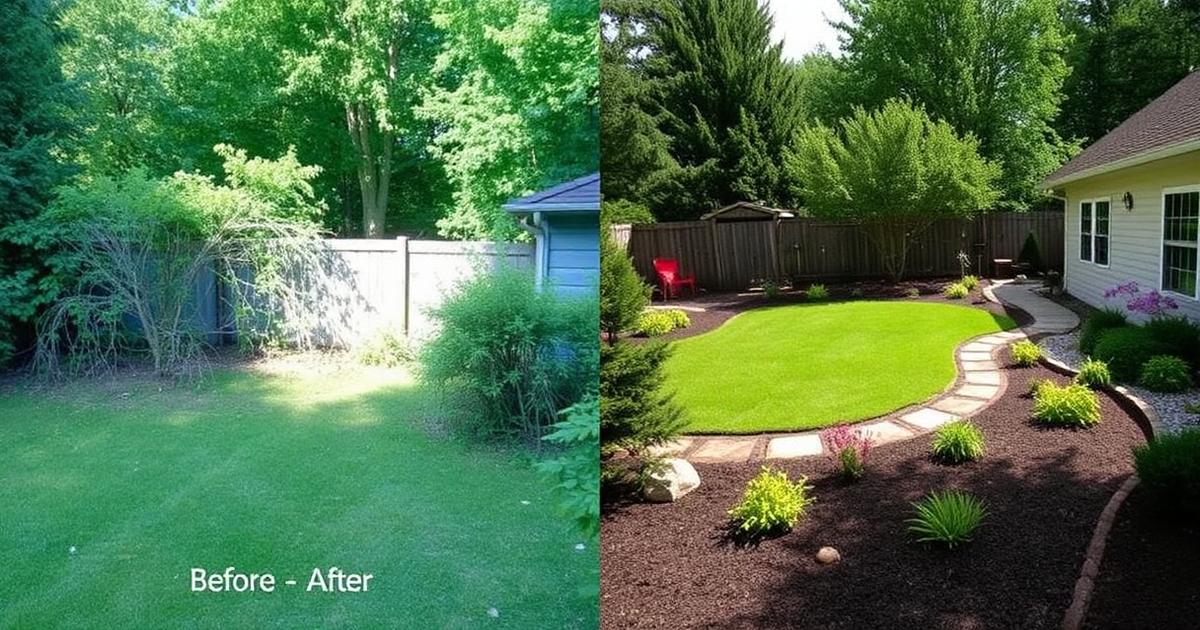
A once-beautiful garden that had become completely overgrown after the previous owner stopped maintaining it. Invasive vines covered fences and climbed trees. Shrubs had grown into impenetrable masses. The original garden structure — stone paths, a pond, and perennial beds — was buried under years of unchecked growth.
The AI Concept
Rather than a complete redesign, the homeowner wanted to reimagine the garden while preserving its mature character. The AI analyzed the overgrown photo and generated a concept that revealed the potential hidden beneath: cleared and restored stone paths, the pond cleaned and replanted, overgrown shrubs replaced with properly scaled alternatives, and a new seating area added where a decayed shed had stood.
After
The restoration took three months of weekend work, mostly done DIY with professional help for tree removal. The homeowner kept the mature trees and existing stone paths, cleared all invasive plants, rebuilt the pond, and planted new shrubs and perennials matching the AI's suggestions. The result felt like the garden had been professionally maintained for decades, not abandoned and then rescued. Total cost: $6,500 (mostly plants and pond supplies).
Transformation 4: The Concrete Jungle Rescue
Before
A backyard that was 80% concrete — a legacy of the previous owner who wanted "zero maintenance." Two huge concrete slabs covered most of the space, with narrow planting strips along the fences containing nothing but bark mulch and a few struggling boxwoods. It felt more like a parking lot than a garden.
The AI Concept
The AI suggested breaking up the concrete in strategic areas rather than removing it entirely (which would have been prohibitively expensive). The concept showed: one concrete slab converted to a gravel garden with Mediterranean plantings, the second slab kept as a patio but softened with container gardens and a built-in planter, and the fence-line strips widened and planted with a mix of evergreen and flowering shrubs.
After
The homeowners rented a concrete saw and broke out approximately 200 square feet of slab over two weekends. They filled the area with compacted gravel and planted lavender, rosemary, ornamental grasses, and a small olive tree. The remaining patio was power-washed and furnished with outdoor dining furniture, surrounded by large planters with seasonal displays. Total transformation cost: $4,200.
Transformation 5: The Family-Friendly Makeover
Before
A mid-size backyard with a tired swing set, scattered toys, and patches of bare earth where kids had worn down the grass. No defined areas, no grown-up spaces, and no visual appeal. The parents loved their children but wanted a backyard that worked for the whole family — not just a playground.
The AI Concept
The AI created a design that balanced kid-friendly features with adult spaces: a dedicated play area with rubber mulch and a modern play structure, a dining patio adjacent to the house, a lawn area for open play, and a fire pit zone for evening relaxation. Planting beds provided separation between zones while keeping sight lines open for supervision.
After
The family replaced the old swing set with a modern wooden play structure on a proper rubber mulch base. They installed a 12×16 paver patio with a dining table that seats eight. A simple fire pit ring with Adirondack chairs went in at the back of the yard. Strategic planting (low ornamental grasses and tough perennials) defined the zones without creating barriers. The lawn, now reduced to the play area, was reseeded with a durable sports turf blend. Budget: $12,000.
Lessons from These Transformations
1. AI Concepts Save Money
Every homeowner in these examples reported that having an AI visualization reduced their project costs. The primary reasons: clearer communication with contractors (fewer change orders), better material estimation (less waste), and more confidence in decisions (no expensive regrets or redo's).
2. Phased Implementation Works
Three of the five projects were completed in phases, spreading the cost and effort over multiple seasons. The AI concept served as the master plan, ensuring that each phase contributed to a cohesive final result rather than creating a patchwork of disconnected improvements.
3. DIY Is More Feasible with a Visual Plan
Two homeowners completed significant portions of their projects themselves. Having a clear visual target made DIY work more approachable — they knew exactly what they were building toward and could break the work into manageable weekend tasks.
4. The "Before" Doesn't Determine the "After"
The most dramatic transformations started from the worst conditions. A neglected or concrete-covered yard isn't a disadvantage — it's an opportunity. The key is seeing potential where others see problems, and that's exactly what AI visualization provides.
Average Costs by Project Type
- Full backyard renovation: $20,000-$50,000 professionally installed
- Patio and planting redesign: $8,000-$20,000
- Garden restoration: $4,000-$12,000
- DIY with professional consultation: $3,000-$8,000
- Phased approach (per phase): $5,000-$15,000
How to Plan Your Own Transformation
- Document your "before" — Take photos from multiple angles, noting what you want to keep and what must go
- Define your priorities — List activities the space must support, ranked by importance
- Set a realistic budget — Include a 15-20% contingency for unexpected costs
- Generate AI concepts — Upload your photo and experiment with multiple design directions
- Get professional quotes — Share the AI visualization with 2-3 landscapers for competitive bids
- Plan your timeline — Consider phased implementation if budget is a constraint
Start Your Backyard Transformation
Upload a photo of your backyard and see its transformation potential. AI generates realistic before-and-after visualizations of your actual space — not stock photos, but your real yard reimagined.
Try AI Backyard Design Free →