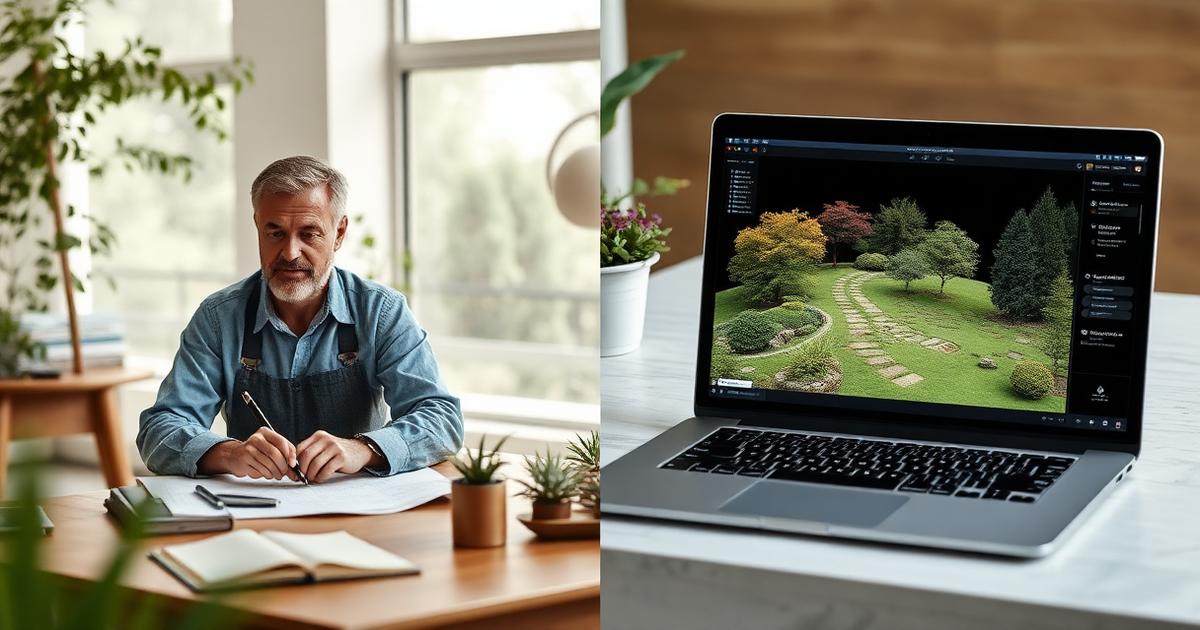
The Traditional Landscape Design Process
Working with a professional landscape designer or architect typically follows a structured process that has remained largely unchanged for decades:
- Initial consultation ($200–$500) — Site visit, needs assessment, style discussion
- Site analysis — Measurements, soil testing, sun mapping, drainage assessment
- Concept design ($1,000–$3,000) — 1–2 hand-drawn or CAD concepts
- Design revisions ($200–$500 each) — Typically 2–3 rounds
- Final design package ($500–$2,000) — Detailed plans, plant schedule, material specifications
- Installation oversight (hourly or percentage) — Ensuring the plan is executed correctly
Total design cost: $2,000–$8,000+ before any plants go in the ground. Timeline: 3–8 weeks from consultation to final plans.
The AI Landscape Design Process
AI landscape design condenses the visualization phase into minutes:
- Photo upload (free) — Take a photo of your yard with your phone
- Style selection (free) — Choose from available design styles or describe your vision
- Generation (seconds) — AI produces realistic design renderings
- Iteration (unlimited) — Generate as many variations as you want
- Comparison (free) — Compare options side by side
Total cost: $0–$50. Timeline: 5–30 minutes for multiple complete concepts.
Head-to-Head Comparison
| Factor | AI Design | Professional Design |
|---|---|---|
| Cost | $0–$50 | $2,000–$8,000+ |
| Speed | Minutes | 3–8 weeks |
| Variations | Unlimited | 2–3 concepts |
| Realism | Good visual quality | Accurate to conditions |
| Plant accuracy | Visually suggestive | Climate-verified |
| Construction plans | None | Detailed specifications |
| Engineering | None | Drainage, grading, structural |
| Local knowledge | None | Soil, climate, regulations |
| Project management | None | Contractor coordination |
Where AI Wins Decisively
Speed of Exploration
The most transformative advantage of AI is speed. In the time it takes to schedule a consultation with a landscape designer, you can generate 20+ design concepts and narrow your vision to a clear direction. This rapid exploration is impossible with traditional methods at any price point.
Low-Risk Experimentation
With a professional, each concept costs money and takes time. This creates pressure to "get it right" early, which paradoxically limits creativity. With AI, there's zero cost to trying wild ideas — a Japanese garden, a tropical paradise, a minimalist desert scape. Many homeowners discover their dream style by experimenting with options they'd never have paid a designer to explore.
Communication Tool
Even if you ultimately hire a professional, AI-generated designs are invaluable communication tools. Showing a designer exactly what you envision (rather than describing it verbally) reduces misunderstandings, revisions, and the overall cost of professional engagement.
Where Professionals Win Decisively
Site-Specific Knowledge
AI doesn't know your soil type, drainage patterns, underground utilities, local regulations, or microclimates. A professional walks your property and identifies issues that no photo can reveal: the spot that floods every spring, the area with hardpan clay 6 inches down, the utility easement that restricts planting.
Plant Expertise
AI generates visually appealing plant arrangements but has no understanding of plant compatibility, mature sizes, growth rates, or regional suitability. A professional selects plants that will actually thrive in your conditions, mature to the right size, and look good together through every season.
Engineering and Safety
Retaining walls over 2 feet need structural engineering. Patios need proper base preparation and grading. Drainage systems need calculated capacity. Outdoor electrical needs code compliance. These technical requirements are invisible in an AI rendering but critical for a successful, safe, and lasting installation.
Long-Term Thinking
A good designer thinks in decades: how trees will shade the house in 20 years, how root systems will interact with foundations, how the garden will look in every season over time. AI shows you a single perfect moment; professionals plan for a lifetime of beauty and functionality.
The Hybrid Approach: Best of Both Worlds
Phase 1: AI Exploration (Free, 1–2 Hours)
Upload your yard photos to AI tools and generate concepts in multiple styles. Identify your preferred style direction, must-have features, and overall aesthetic. Save your top 3–5 designs with notes about what you love in each.
Phase 2: Professional Refinement ($1,000–$3,000)
Bring your AI concepts to a landscape designer. Because you've already established your vision, the designer can skip the lengthy exploration phase and move directly to refinement: selecting appropriate plants, engineering solutions, and creating construction-ready documents.
Phase 3: Informed Installation
Whether you DIY or hire contractors, you now have both the vision (AI) and the technical plan (professional). This combination produces the best outcomes at the lowest total cost.
Who Should Use AI Only?
- Homeowners doing simple projects (planting beds, container gardens, minor updates)
- Budget-conscious DIYers with gardening knowledge
- Renters or temporary residents who want quick improvements
- Anyone in the early exploration phase who isn't ready to commit to a project
Who Should Hire a Professional?
- Projects involving structural elements (retaining walls, elevated decks, pergolas)
- Significant grading or drainage work
- Whole-property transformations with $20,000+ budgets
- Properties with complex conditions (steep slopes, poor soil, wetland adjacency)
- Anyone who wants a guaranteed result and doesn't want to manage the process
The Bottom Line
AI hasn't replaced professional landscape design — it's democratized the visualization phase. Every homeowner can now explore design possibilities that were previously locked behind expensive consultations. Use AI to dream, explore, and communicate. Use professionals to engineer, specify, and build. The combination produces better results than either approach alone.
Start Exploring with AI
Upload your yard photo and generate design concepts in minutes. Whether you ultimately go DIY or hire a professional, AI visualization is the perfect first step for any landscape project.