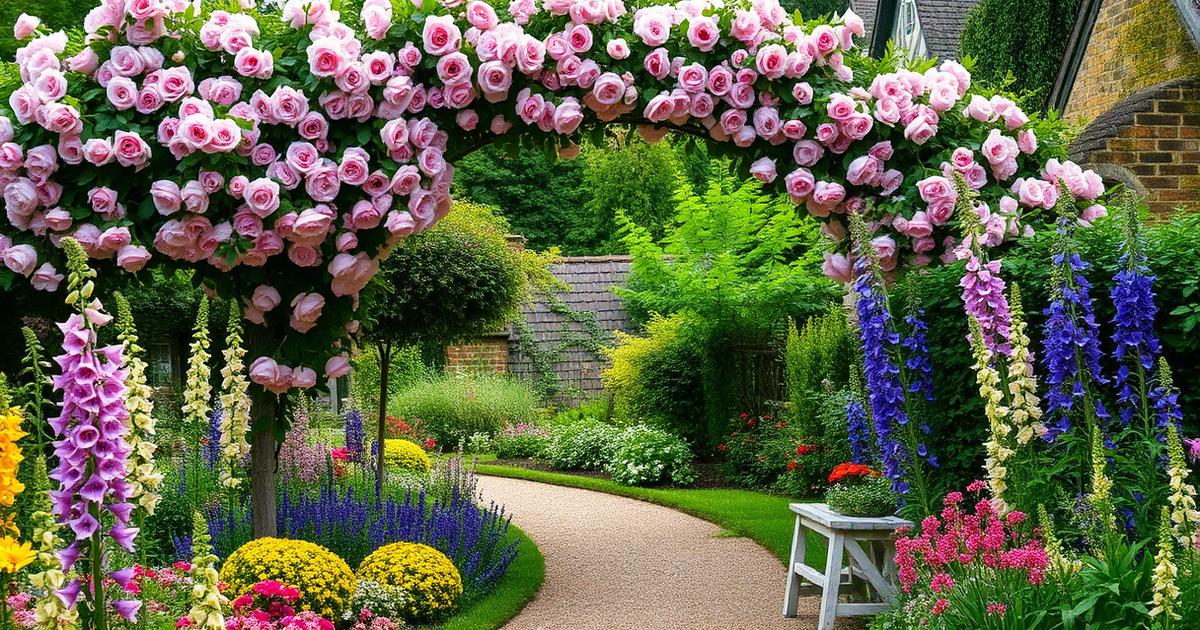
What Makes a True Cottage Garden?
The cottage garden style originated in rural England centuries ago, born from necessity rather than design theory. Cottagers grew a mix of flowers, herbs, and vegetables in dense, informal plantings around their homes. The result was a charming abundance that modern gardeners have been trying to recreate ever since.
A true cottage garden has several defining characteristics: dense, layered plantings that fill every available space; a mix of plant types including perennials, annuals, herbs, and sometimes edibles; soft, informal structure with plants spilling over edges and self-seeding freely; and romantic focal points like arbors, gates, birdbaths, and meandering paths.
The paradox of cottage gardens is that achieving this "effortless" look actually requires careful planning. Without structure, a cottage garden becomes a weed patch. Without the right plant combinations, it looks chaotic rather than charming. This is exactly where AI design tools provide enormous value.
The Structural Framework: Bones of a Cottage Garden
Paths and Walkways
Every cottage garden needs a path — it's what transforms a planted area from a field into a garden. Traditional cottage gardens use brick, flagstone, or gravel paths, often deliberately narrow to encourage plants to spill over the edges. The path should feel like it's discovering its way through the plantings, not imposing order on them.
Curved paths work better than straight ones for cottage gardens. They create the sense of mystery and discovery that defines the style. Even in a small garden, a path that curves behind a tall planting creates the illusion of a larger, more complex space.
Vertical Elements
Cottage gardens rely heavily on vertical structure: arbors and arches draped with climbing roses or clematis; obelisks and tripods supporting sweet peas or morning glories; fences and walls softened by espaliered fruit trees or rambling vines. These vertical elements add height, romance, and the layered depth that makes cottage gardens so visually rich.
AI tools can visualize these vertical elements in your space, showing how an arbor over your front gate or a rose-covered trellis against your fence would transform the garden's character.
Focal Points and Gathering Spots
A bench tucked into an alcove of flowering shrubs, a birdbath surrounded by lavender, a sundial at the intersection of two paths — cottage gardens need destinations. These focal points give the eye somewhere to rest amid the abundant plantings and create intimate moments within the larger garden.
Essential Cottage Garden Plants
The Foundation Layer: Perennial Backbone
- English Roses (David Austin varieties) — The quintessential cottage plant. Repeat-blooming varieties like 'Abraham Darby' and 'Gertrude Jekyll' provide fragrance and romance from June through frost
- Delphiniums — Tall spires of blue, purple, and white that define the classic cottage border. Stake them and they'll reward you with dramatic vertical color
- Peonies — Lush, fragrant blooms in late spring. Once established, they bloom reliably for decades with minimal care
- Foxgloves — Biennial spires that self-seed freely, creating that natural, established look within a few years
- Hollyhocks — Classic cottage sentinels that stand tall against walls and fences. Self-seeding and old-fashioned in the best way
The Filler Layer: Mid-Height Interest
- Catmint (Nepeta) — Soft blue-purple billows that edge paths beautifully. Cut back after first flush for repeat blooms
- Lady's Mantle (Alchemilla) — Chartreuse flowers and velvety leaves that catch raindrops like jewels
- Hardy Geraniums — Long-blooming, ground-covering, and available in dozens of varieties from white to deep purple
- Lavender — Fragrant, evergreen structure and pollinator magnet. Essential for the cottage garden scent profile
- Dianthus — Spicy-scented, old-fashioned "pinks" that have been cottage garden staples for centuries
The Weaver Layer: Self-Sowing Annuals
- Sweet Peas — Fragrant climbing annuals that define English cottage gardens. Grow on obelisks or trellises
- Nigella (Love-in-a-Mist) — Delicate blue flowers followed by ornamental seed pods. Self-seeds enthusiastically
- Cosmos — Tall, airy flowers that fill gaps and bloom continuously from midsummer to frost
- Calendula — Bright orange and yellow edible flowers. Self-seeds and provides long-season color
- Sweet William — Clustered flowers with intricate patterns. Old-fashioned charm and wonderful fragrance
Planning Your Cottage Garden Borders
The Layering Principle
Successful cottage garden borders follow a simple rule: tall at the back, medium in the middle, low at the front — but with intentional exceptions. A few tall plants like verbena bonariensis (which is transparent enough to see through) can be placed mid-border to add depth and movement.
In a typical 6-foot deep border:
- Back (5-6 feet): Delphiniums, hollyhocks, tall roses, climbing plants on supports
- Mid-border (3-4 feet): Peonies, phlox, campanula, medium shrub roses
- Front (1-2 feet): Catmint, geraniums, dianthus, alchemilla, low herbs
- Edge spillers (ground level): Thyme, aubrieta, campanula portenschlagiana
Color Harmony in Cottage Gardens
Traditional cottage gardens follow two main color approaches:
The Pastel Palette: Soft pinks, lavenders, pale blues, whites, and creamy yellows. This creates the classic romantic, dreamy atmosphere associated with English cottage gardens. Think of Sissinghurst's famous White Garden as the ultimate expression of this approach.
The Jewel Palette: Deep purples, rich reds, hot oranges, and bright yellows. More dramatic and less common, but equally valid. Think of Great Dixter, where Christopher Lloyd pushed cottage gardening into bold, unconventional color combinations.
AI design tools let you experiment with both palettes in your space before committing to plants. You can see whether soft pastels or bold jewel tones work better with your house color and existing garden context.
Cottage Garden Design for Different Spaces
Front Yard Cottage Garden
A cottage-style front garden replaces the typical lawn-and-foundation-planting formula with something far more charming. Replace the lawn with a winding path from sidewalk to door, flanked by overflowing borders. Add a picket fence or low stone wall to frame the garden and provide structure.
Key considerations for front yards: maintain sight lines for safety, keep paths wide enough for two people, and choose plants that look good across multiple seasons (not just a two-week bloom window).
Small Space Cottage Gardens
Cottage style actually works brilliantly in small spaces. A tiny courtyard or balcony can capture the essence with a few key elements: one climbing rose on a wall, a collection of pots with herbs and flowers, a small birdbath, and some self-seeding annuals tucked into cracks. The abundance that defines cottage style is about density of planting, not acreage.
Modern Cottage Garden Hybrid
A contemporary twist on the cottage garden maintains the dense, informal planting style but uses a more edited plant palette and cleaner hardscaping. Think: structured gravel paths, corten steel edging, ornamental grasses mixed with traditional cottage perennials. This hybrid approach appeals to homeowners who love the romanticism but want a slightly more contemporary feel.
Seasonal Planning for Year-Round Interest
The best cottage gardens offer something in every season:
Spring: Bulbs (tulips, narcissus, alliums), bleeding hearts, forget-me-nots, apple blossom
Early Summer: Roses, peonies, foxgloves, delphiniums, sweet peas — the peak cottage garden moment
Late Summer: Phlox, echinacea, rudbeckia, dahlias, cosmos picking up where early performers fade
Autumn: Japanese anemones, sedums, ornamental grasses, late roses, colorful foliage
Winter: Evergreen structure (box hedging, yew, holly), dried seed heads, winter-blooming hellebores
How AI Transforms Cottage Garden Planning
Traditionally, planning a cottage garden required years of trial and error, expensive mistakes, and deep plant knowledge. You'd plant something, wait a season to see how it looked, realize the colors clashed or the heights were wrong, and start over.
AI design tools compress this learning curve dramatically:
- Upload a photo of your current garden or yard
- Select cottage garden style — the AI understands the characteristic elements
- See instant visualization of how cottage-style plantings would look in your space
- Experiment with variations — try different color palettes, path layouts, focal points
- Generate a planting plan — know exactly what to plant and where
The AI handles the complex spatial relationships — how tall plants will frame your house, where paths should flow, how borders will look from different angles — that even experienced gardeners struggle to envision from a blank slate.
Cottage Garden Quick-Start Formula
For a 10×6 foot border that captures authentic cottage garden feel: Plant 3 roses (back), 5 peonies or phlox (mid), 7 catmint or geraniums (front), add 1 climbing plant on a support, and scatter seeds of nigella and cosmos throughout. Mulch with fine bark and let plants knit together over the first two seasons.
Maintaining Your Cottage Garden
Despite their wild appearance, cottage gardens do need regular care — but it's pleasant, meditative work rather than heavy labor:
- Deadheading — Remove spent flowers weekly to encourage repeat blooming
- Staking — Support tall plants like delphiniums and peonies before they flop
- Editing — Remove self-seeded plants that appear where you don't want them
- Seasonal cutbacks — Cut perennials to ground level in late winter
- Feeding — Annual mulch application and occasional organic fertilizer
Design Your Cottage Garden Today
Upload a photo of your garden and see how romantic cottage-style plantings would transform your space. Experiment with paths, borders, and plant combinations — all visualized on your real garden photo.
Try AI Garden Design Free →