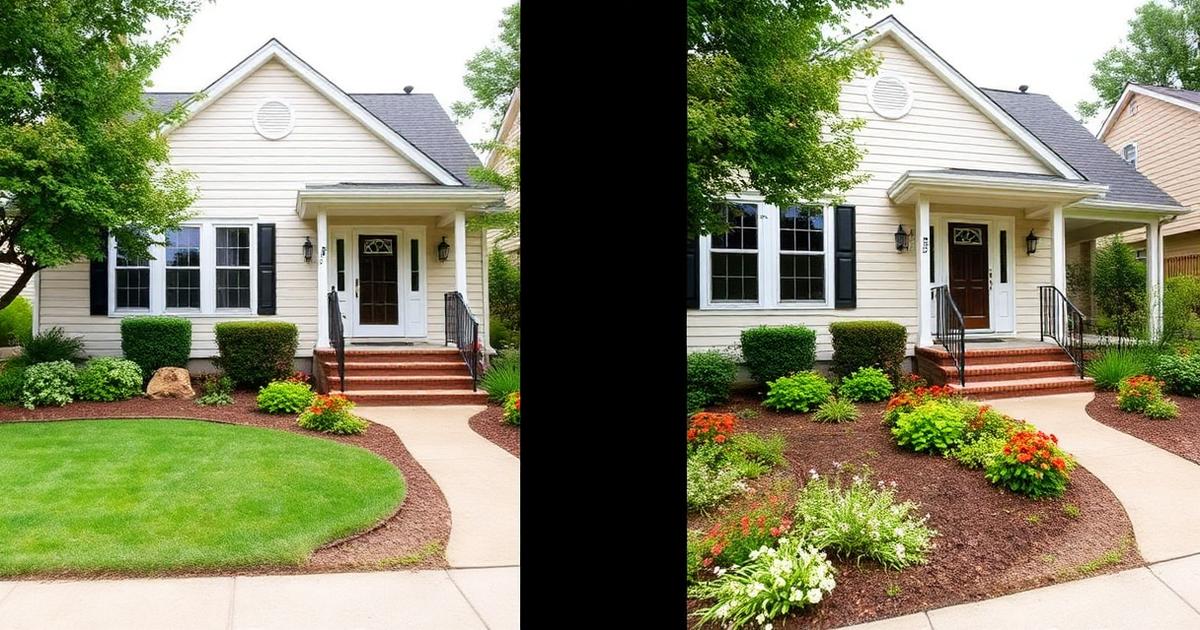
Why Front Yard Transformations Have the Highest Impact
Your front yard is seen by every person who passes your home, every visitor who arrives, and you yourself every single day. Yet most front yards receive the least design attention of any outdoor space. According to landscape industry surveys, homeowners spend 4x more on backyard improvements than front yard upgrades — despite front yard improvements delivering a higher return on investment.
The reason is simple: backyards are for living; front yards are for looking. But this distinction undersells the impact of a well-designed front yard on your daily satisfaction, your home's value, and your neighborhood's character. A thoughtfully designed front yard can increase your home's perceived value by 10-15% and make you smile every time you pull into your driveway.
Transformation 1: The Builder-Basic Ranch
Before
A 1970s ranch home with the original landscaping: two overgrown yews flanking the front door, a row of Bradford pear trees along the street, a concrete walkway with settling cracks, and a struggling lawn of mixed grass and weeds. The house had good bones but the landscape was dated and depressing.
AI Design Concept
The homeowner uploaded a street-level photo and selected a "modern farmhouse" design direction. The AI generated a concept showing: the yews removed and replaced with layered foundation plantings (boxwood, hydrangeas, and ornamental grasses), a new bluestone walkway with a gentle curve, two columnar trees framing the entry, and a defined garden bed at the street edge with a low stone border.
After
The renovation took three weekends of DIY work plus one day of professional help for the walkway. The Bradford pears were removed (they were starting to split), replaced by two Zelkova trees that would provide better shade and shape. Foundation plantings went in exactly as the AI suggested. The new walkway transformed the entire approach to the house. The lawn was dethatched, overseeded, and edged sharply. Total cost: $7,200.
The homeowner reported that neighbors stopped to compliment the transformation within the first week, and a real estate agent neighbor estimated the improvements added $25,000-$30,000 to the home's value.
Transformation 2: The Lawn Desert
Before
A newer suburban home in a hot climate (Zone 9) with nothing but a dying lawn, a concrete driveway, and two builder-installed shrubs by the garage. Water bills were $200/month just to keep the lawn half-alive, and it still looked terrible from June through September. Zero shade, zero personality, zero reason to look at it.
AI Design Concept
The AI generated a drought-tolerant Mediterranean-inspired concept: the lawn eliminated entirely and replaced with decomposed granite, gravel, and strategic planting zones. Native and adapted plants — agave, red yucca, sage, and ornamental grasses — grouped in organic-shaped beds. A meandering decomposed granite path from the driveway to the front door, with a small courtyard seating area near the entry.
After
The transformation was dramatic. The dead lawn was removed and replaced with a combination of decomposed granite (main paths and open areas), river rock (accent zones), and planting beds with drip irrigation. Plants included agave, desert marigold, purple sage, Mexican feather grass, and two desert museum palo verde trees for eventual shade.
Monthly water bills dropped from $200 to $35. Maintenance time dropped from 4 hours per week to 30 minutes. And the home went from the blandest on the block to the most interesting. Total investment: $9,500.
Transformation 3: The Overgrown Victorian
Before
A beautiful Victorian home completely hidden behind decades of unchecked growth. Giant rhododendrons covered the first-floor windows. Ivy had consumed the porch railings and was creeping under the siding. A massive cypress blocked all sunlight from the front rooms. The house was charming — you just couldn't see it.
AI Design Concept
The AI recognized the house's architectural character beneath the overgrowth and generated a concept that respected the Victorian aesthetic: the oversized shrubs removed and replaced with properly scaled cottage-style plantings (hydrangeas, roses, lavender, boxwood), the ivy cleared from the porch and replaced with trained climbing roses on a wire system, the cypress removed to reveal the house facade, and a restored brick walkway lined with perennial borders.
After
The first phase was removal: the cypress came down, overgrown shrubs were extracted, ivy was carefully removed without damaging the porch woodwork. This alone was transformative — neighbors said it was like seeing the house for the first time in years. Phase two was replanting following the AI concept: David Austin roses along the front fence, layered foundation plantings scaled to the windows, and the brick walkway repair. Total over two phases: $11,000.
Transformation 4: The Cookie-Cutter Subdivision
Before
A home in a development where every house had identical landscaping: two Japanese hollies, three azaleas, a strip of monkey grass, and a lawn. Multiply this by 200 houses and you get a neighborhood where no home has any identity. The homeowner wanted to stand out without looking out of place.
AI Design Concept
The AI generated a concept that elevated the design while maintaining neighborhood compatibility: the standard foundation shrubs replaced with a varied mix of evergreen and flowering plants in layered heights, a curved walkway replacing the straight concrete path, a small ornamental tree (Japanese maple) as a focal point in the front bed, and landscape lighting highlighting the key features.
After
The homeowner executed the plan over a single weekend with help from friends. The existing hollies and azaleas were donated to a community garden. In went a mix of boxwood, knockout roses, fountain grass, blue star juniper, and a beautiful laceleaf Japanese maple. The old straight walkway was replaced with stepping stones set in a gentle curve through a bed of creeping thyme. Solar path lights completed the transformation. Total cost: $3,800 — the most budget-friendly renovation in this roundup and arguably the most impactful per dollar spent.
Transformation 5: The Multi-Generational Home Entry
Before
An older home where the front entry had two narrow concrete steps, no railing, and a steep slope from the driveway to the door. The homeowner's parents were moving in and needed an accessible, safe approach to the house. Function drove the redesign, but the result needed to look good too.
AI Design Concept
The AI generated a concept with universal design principles: a gently sloping walkway replacing the stairs, wide enough for a wheelchair with room for a companion alongside, elegant handrails that looked like garden features rather than medical equipment, and planting that defined the path edges while maintaining clear sight lines for safety.
After
A professional contractor built the new walkway: a 5-foot-wide paver path with a gentle 1:12 slope, brushed aluminum railings, integrated step lighting, and wide landing areas at the door and driveway. Raised planters along the path edges contained low-maintenance evergreens and seasonal flowers. The result was a front entry that was fully accessible while looking like a designed landscape feature, not a medical accommodation. Total cost: $14,500.
Key Lessons from These Transformations
Lesson 1: Removal Is Often the First Step
Three of five transformations started by removing overgrown, oversized, or inappropriate plants. Sometimes the best design move is subtraction. Don't be afraid to remove plants that don't serve the design — even large, established ones.
Lesson 2: The Walkway Sets the Tone
Four of five transformations included a new or modified walkway. The path to your front door is the narrative of your curb appeal — it deserves premium attention and materials.
Lesson 3: Scale Matters More Than Species
The most common mistake across all "before" photos was plants too large for their location. Every "after" featured properly scaled plantings that enhanced the house rather than hiding it.
Lesson 4: AI Concepts Reduce Risk
Every homeowner cited the AI visualization as critical to their confidence. Seeing the result before committing eliminated the "what if" anxiety that prevents many people from starting front yard improvements.
Planning Your Front Yard Transformation
- Photograph your house — Stand across the street, capturing the full facade, current landscaping, walkway, and driveway
- Identify what bothers you — Write down your top 3 frustrations with the current front yard
- Set your budget — Even $2,000-$5,000 can make a significant difference
- Generate AI concepts — Upload your photo and experiment with different style directions
- Prioritize changes — If budget is limited, start with the walkway and foundation planting
- Execute with confidence — Use the AI visualization as your guide
See Your Front Yard Transformation
Upload a photo of your home and get an AI-generated visualization of how improved landscaping would boost your curb appeal. See the potential — then make it happen.
Try AI Curb Appeal Design Free →