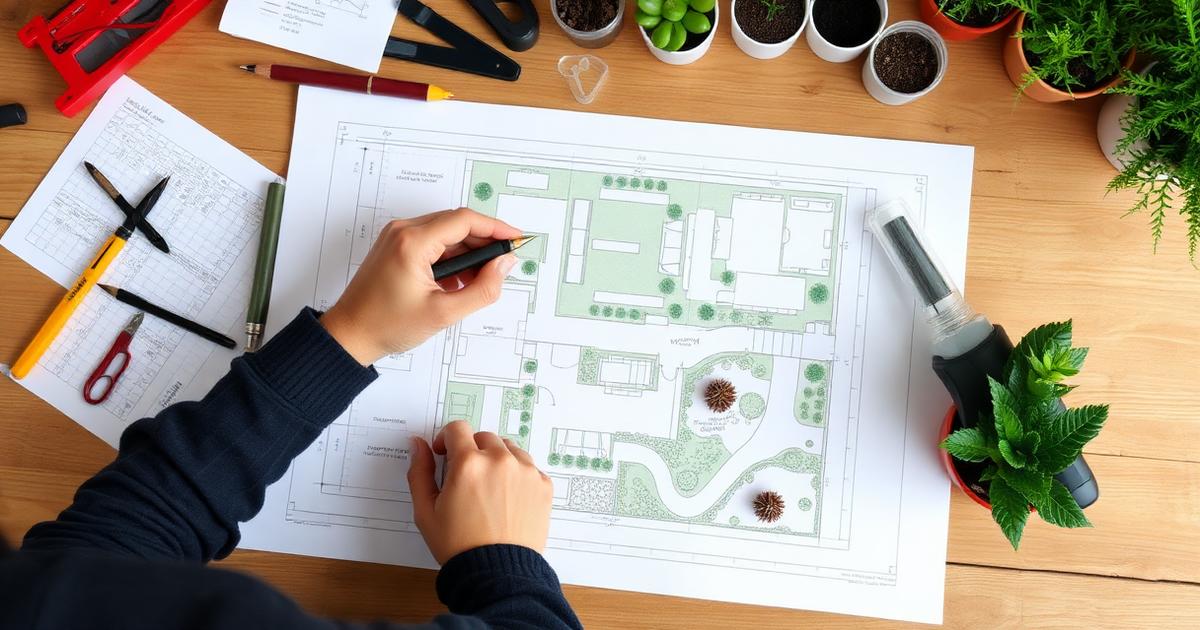
Why DIY Landscape Design Makes Sense in 2025
The traditional path to a beautiful yard involved hiring a landscape architect ($2,000–$10,000 for design alone), waiting weeks for concepts, and paying for revisions when the first draft didn't match your vision. For many homeowners, this cost and timeline made professional design inaccessible, leaving them to guess their way through Home Depot's garden center.
AI has changed the equation entirely. Today, you can upload a photo of your yard and see it transformed into a professional-looking design in under a minute. You can generate dozens of variations, experiment with different styles, and narrow down exactly what you want — all before spending a dollar on plants or materials.
This doesn't mean AI replaces all professional expertise. Soil analysis, grading, irrigation engineering, and hardscape construction still benefit from professional involvement. But the design and visualization phase — the most expensive part of working with a landscape architect — is now something you can handle yourself.
Getting Started: What You Need
Tools and Equipment
- A smartphone or camera — For taking photos of your yard from multiple angles
- A measuring tape or laser measurer — For understanding your space dimensions
- Graph paper or a digital sketching app — For rough planning
- AI landscape design tool — For generating visual concepts
- A notebook — For tracking ideas, plant lists, and budgets
Know Your Space
Before generating any designs, gather this critical information about your yard:
- Sun exposure — Track which areas get full sun (6+ hours), partial shade (3–6 hours), or full shade (less than 3 hours) throughout the day
- USDA Hardiness Zone — This determines which plants will survive your winters
- Soil type — Sandy, clay, loam, or rocky. A simple $15 soil test kit reveals pH and nutrient levels
- Drainage patterns — Where does water pool after rain? Where does it flow?
- Existing utilities — Call 811 before any digging to locate underground lines
Phase 1: Vision and Inspiration
Define Your Goals
Before opening any design tool, answer these questions:
- What's the primary purpose of this space? (Entertaining, relaxation, play area, curb appeal)
- How much maintenance are you willing to do? (Be brutally honest)
- What's your total budget? (Including plants, materials, tools, and delivery)
- Do you want to do the work yourself, or hire help for installation?
- What elements are non-negotiable? (Privacy screening, shade, outdoor cooking, etc.)
Use AI for Rapid Exploration
This is where AI truly shines for DIY designers. Upload your yard photo and generate designs in multiple styles:
- Generate a modern minimalist version
- Generate a cottage garden version
- Generate a Mediterranean version
- Generate a low-maintenance xeriscape version
Compare them side by side. Notice what draws your eye in each design. Maybe you love the stone pathway from the modern design but the plant fullness from the cottage garden. These preferences become the foundation of your personal design brief.
Phase 2: Planning Your Layout
The Zone Approach
Professional designers divide yards into functional zones. Apply this to your DIY project:
- Zone 1 — Public zone — Front yard, visible from the street. Focus on curb appeal and welcoming entry.
- Zone 2 — Transition zone — Side yards, pathways connecting front and back. Functional but can be beautiful.
- Zone 3 — Living zone — Main backyard area for dining, entertaining, and relaxing. Your primary investment area.
- Zone 4 — Utility zone — Storage, compost, AC units, trash bins. Screen these from view.
- Zone 5 — Wild zone — Areas you can let grow naturally. Low maintenance, wildlife-friendly.
Creating Focal Points
Every successful landscape has focal points — elements that draw the eye and give the space structure. A focal point can be a specimen tree, a water feature, an ornamental gate, a fire pit, or a dramatic planting bed. Place your primary focal point where it's visible from your most-used viewpoint (usually from inside the house looking out).
Pathways and Flow
Design pathways before plantings. How do people move through your space? Primary paths (front door to driveway, back door to patio) should be wide (4+ feet), direct, and stable. Secondary paths (through garden beds, to a bench) can be narrower and more meandering. Materials should match your overall style: flagstone for natural looks, pavers for clean lines, gravel for cottage style.
Phase 3: Plant Selection
The Layering Technique
Professional plantings use layers to create depth and visual interest:
- Canopy layer — Tall trees providing shade and vertical structure (15+ feet)
- Understory layer — Small trees and large shrubs (6–15 feet)
- Shrub layer — Medium shrubs for screening and structure (3–6 feet)
- Herbaceous layer — Perennials, grasses, and ground covers (0–3 feet)
- Ground layer — Mulch, ground covers, or gravel
Color Theory for Gardens
Use color strategically:
- Monochromatic — Variations of one color (e.g., all whites and creams) for elegant, cohesive beds
- Analogous — Adjacent colors on the wheel (e.g., blues and purples) for harmonious schemes
- Complementary — Opposite colors (e.g., purple and yellow) for vibrant, energetic designs
- Cool colors (blues, purples, whites) make spaces feel larger and more serene
- Warm colors (reds, oranges, yellows) create excitement and feel closer
Year-Round Interest
Don't design for just one season. Ensure something is happening in every month:
- Spring — Bulbs, flowering trees, fresh foliage
- Summer — Perennials, annuals, lush greenery
- Autumn — Fall foliage, ornamental grasses, seed heads
- Winter — Evergreen structure, bark interest, berries, dried grasses
Phase 4: Budgeting and Phasing
Realistic Cost Estimates
| Element | DIY Cost | Professional |
|---|---|---|
| Patio (200 sq ft pavers) | $800–$1,500 | $3,000–$6,000 |
| Pathway (30 ft flagstone) | $400–$800 | $1,500–$3,000 |
| Planting bed (100 sq ft) | $200–$500 | $800–$2,000 |
| Privacy hedge (20 ft) | $300–$600 | $1,000–$2,500 |
| Landscape lighting (6 fixtures) | $200–$500 | $1,500–$3,000 |
The Phased Approach
Don't try to do everything in one weekend. Plan a multi-year phased approach:
- Year 1 — Infrastructure: hardscape, major grading, irrigation if needed
- Year 2 — Structure planting: trees, large shrubs, hedges
- Year 3 — Detail planting: perennials, ground covers, accents
- Year 4+ — Refinement: lighting, furniture, seasonal color, fine-tuning
Phase 5: Installation Tips
Hardscape First, Always
Install all hardscape (patios, walkways, walls, raised beds) before planting anything. Heavy equipment and material delivery will damage new plantings. Get the bones of the garden in place, then add the soft elements.
Planting Technique
The most common DIY planting mistake is digging holes too deep and too narrow. The correct approach: dig twice as wide as the root ball but only as deep. The top of the root ball should be level with or slightly above the surrounding soil. Backfill with native soil (not amendment), water deeply, and mulch 2–3 inches thick, keeping mulch away from stems.
Watering Wisdom
New plantings need consistent moisture for the first growing season while roots establish. Deep, infrequent watering (1 inch per week) is better than frequent light watering. Consider installing drip irrigation — it's a straightforward DIY project that saves water and time.
Start Your DIY Design Journey
Upload a photo of your yard and see AI-generated design concepts in minutes. It's the perfect first step for any DIY landscape project — visualize your ideas before you dig.