Why Lighting Is the Most Underrated Landscape Investment
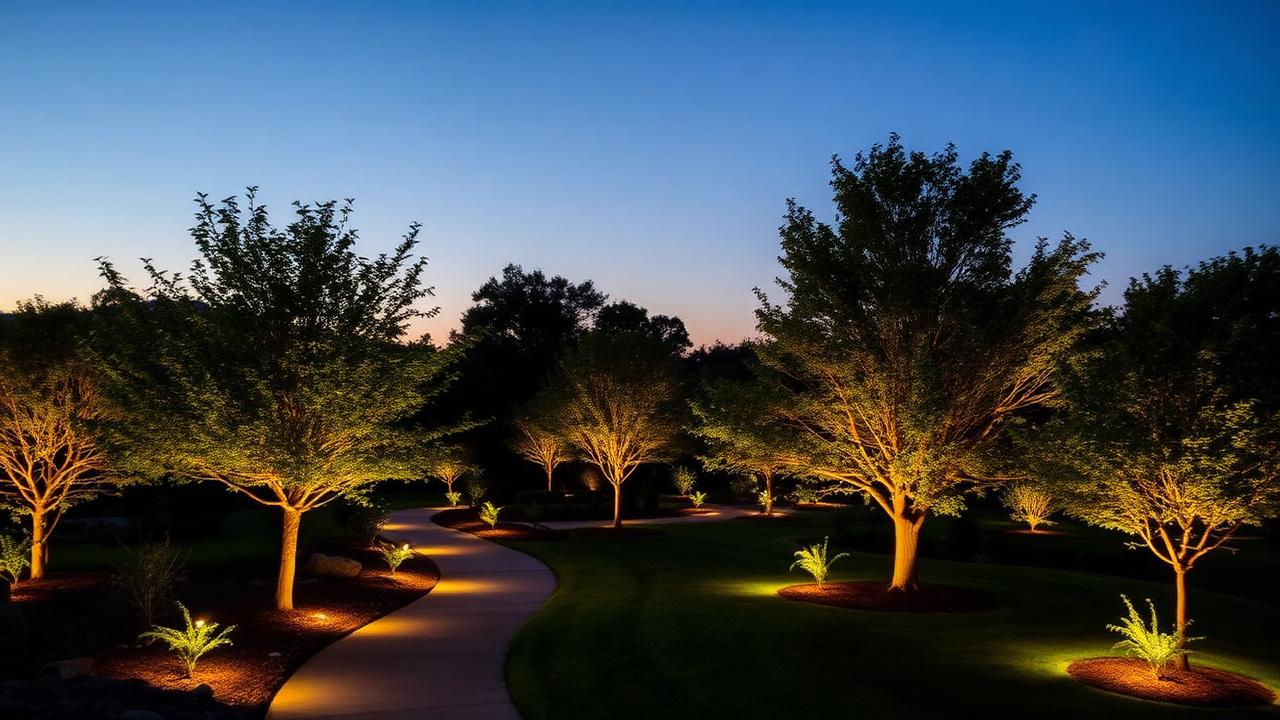
A homeowner will spend 30,000 dollars on a patio they use for 4 months at 2 hours per evening — and skip the 3,000 dollar lighting plan that would let them use it for 6 months at 4 hours per evening. Good landscape lighting effectively doubles the usable hours of an outdoor space.
It also transforms how the front of the house reads at night. A well-lit facade with uplit trees and a glowing path is the difference between a home that disappears after sunset and one that looks like a destination.
The Five Lighting Techniques You Need to Know
1. Uplighting
Fixtures placed at ground level shine upward into trees, walls, or architectural features. Uplit trees are the single highest-impact landscape lighting move — a mature maple with two well-placed uplights becomes the centerpiece of the yard at night.
2. Downlighting (Moonlighting)
Fixtures mounted high in trees or on the house, shining downward to mimic moonlight. The effect is soft, dappled, and natural. Excellent over patios, paths, and seating areas.
3. Path Lighting
Low fixtures along walkways, casting circles of light onto the path. Functional, but easy to overdo. The classic mistake is the "runway" — a row of bright path lights every 4 feet that looks like an airport. Space them 8–10 feet apart and use lower-output fixtures than you think you need.
4. Wall Washing / Grazing
Fixtures aimed at a wall or fence to reveal texture. A stone wall lit with grazing light becomes a feature; the same wall lit with flood becomes a billboard. Aim for low intensity and shallow angles.
5. Feature / Accent Lighting
Targeted fixtures highlighting specific elements — a sculpture, a water feature, a specimen plant. Use sparingly. Three feature lights are dramatic; ten are a theme park.
Color Temperature Matters Enormously
Landscape lighting comes in different color temperatures, measured in Kelvin (K). The wrong choice ruins everything else.
- 2700K (warm white): the standard for residential landscape lighting. Inviting, complementary to most stone and wood.
- 3000K (neutral warm): slightly cooler, works for modern architecture and lighter materials.
- 4000K and above (cool white / daylight): avoid in residential landscapes. They make plants look gray and patios look like parking lots.
Mix temperatures within a yard at your peril. Stick to one color across all fixtures — most professionals choose 2700K and never deviate.
Using AI to Preview Your Night Landscape
This is where AI design tools become genuinely magical. Generating a night-lit version of your yard from a daytime photo lets you see the impact of different lighting strategies without spending a dollar on fixtures. You can compare uplit trees against downlighting against path-only lighting and pick the look you want.
Effective prompts:
- "Front yard at night, two large uplit oak trees, soft path lighting along walkway, warm 2700K lighting, glowing front entry"
- "Backyard patio at dusk, downlights mounted in trees casting moonlight effect, low accent lights on stone wall"
- "Modern minimalist front yard at night, single uplit Japanese maple, washed concrete wall behind, no path lighting"
- "Cottage garden at night, soft warm lighting on three specimen shrubs, lantern-style path lights, glow from windows"
Where to Place Fixtures
Trees
Two uplights per major tree, placed 3–6 feet from the trunk and aimed up into the canopy. For very large trees, add a third light from a different angle.
Architectural Features
Front entry: one well-placed downlight or two flanking sconces. Stone walls or columns: grazing light from below or above.
Paths
One light every 8–10 feet, alternating sides if the path is wide. Lower-intensity fixtures spaced further apart beat bright fixtures spaced close.
Seating Areas
Avoid lighting the seating area itself directly. Light the surrounding landscape and let ambient light spill into the seating zone. Direct light at face level ruins the atmosphere.
Low-Voltage vs. Line-Voltage
Almost all residential landscape lighting today is low-voltage (12V) LED. Safer to install (no permits or electricians required for the wiring downstream of the transformer), more efficient, and the fixtures are smaller. Line-voltage (120V) systems are essentially obsolete for residential use.
Plan for one transformer per zone, sized at 80 percent of total fixture wattage. A typical front yard plan might use a single 150W transformer feeding 12–15 fixtures.
Smart Controls Are Worth It
Modern transformers with smart controls cost 100–200 dollars more than basic timers but let you schedule different scenes (full lighting until 11pm, accent only until 1am, off after that), adjust dimming, and control everything from your phone. Worth every dollar.
Common Mistakes
- Too bright: the most common mistake. Use lower-output fixtures than the salesperson recommends.
- Too many fixtures: a few well-placed lights beat many average ones.
- Wrong color temperature: 4000K destroys atmosphere. Specify 2700K and check before installation.
- Glare: any visible bulb is a failure. Use shielded fixtures and aim them away from sight lines.
- No dark sky compliance: your neighbors hate up-spill. Use full-cutoff fixtures where possible.
Conclusion
Landscape lighting is the single highest-leverage investment you can make in an existing yard. It transforms how your home looks from the street and doubles the time you spend outdoors. Use AI tools to preview the effect, choose restrained over bright, and commit to 2700K. The result will look like a professional installation — because the planning was professional even if the install was not.