Why Sloped Yards Are Difficult (and Worth the Effort)
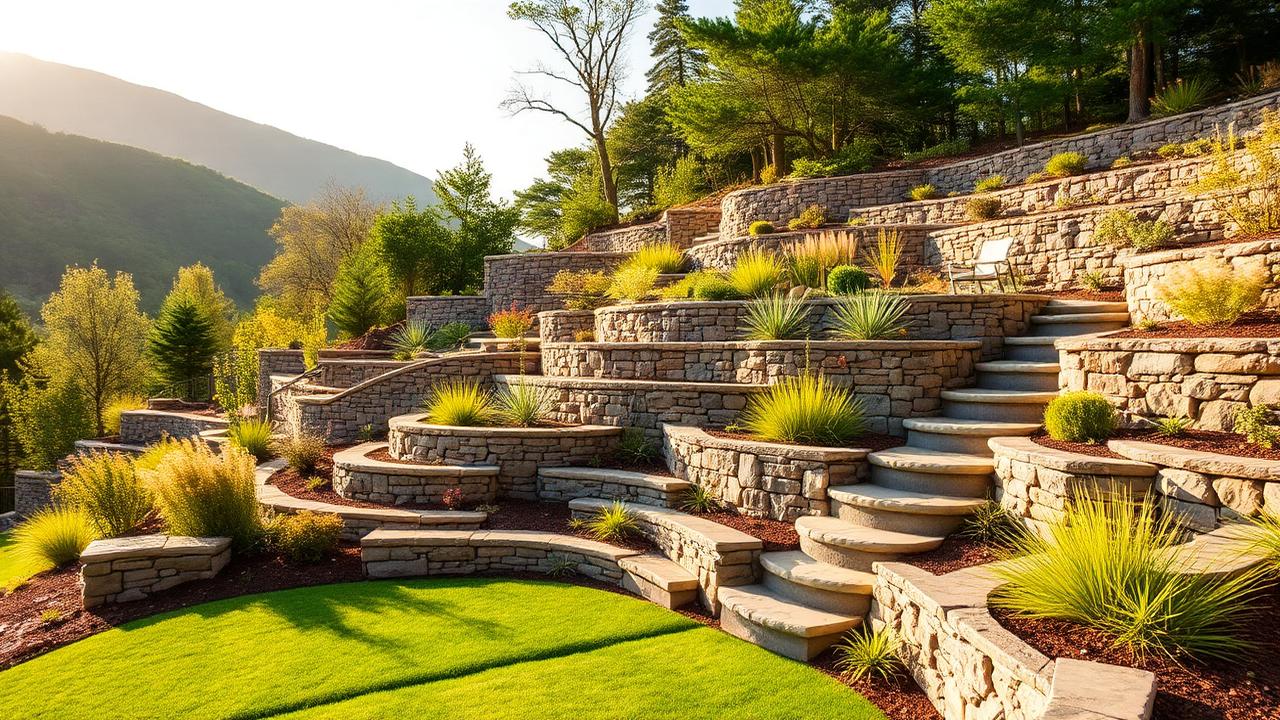
Slopes create real problems: water runs off and erodes soil, mowing is dangerous, and planting is harder because young roots wash out. But slopes also create opportunities flat yards never have. A well-designed sloped backyard can include water features that flow naturally, viewing terraces with elevated perspective, and dramatic plantings that read like a hillside garden in Tuscany or Japan.
The cost of getting it wrong is high — retaining walls and grading are expensive to redo. That is why visualizing the design in advance matters so much.
Strategy 1: Terracing
Terracing breaks a steep slope into a series of flat or near-flat levels. Each terrace is held in place by a retaining wall, and the levels become usable space — patio, lawn, garden, seating area. This is the most powerful slope strategy because it converts unusable hillside into functional outdoor rooms.
Best for: moderate to steep slopes (15–40% grade) with enough horizontal space to absorb the wider footprint.
Materials: stacked stone, poured concrete, timber, gabion baskets, or natural boulders. Stacked stone reads classic and timeless. Concrete reads modern. Timber is cheaper but has a 15–25 year lifespan.
Strategy 2: Single Retaining Wall
One large wall holds back a slope, creating a single flat level above or below. Less complex than full terracing but limited to slopes where one wall can do the work — typically under 6 feet of height drop.
Best for: moderate slopes near the house, where you want a level lawn or patio adjacent to the building.
For walls over 4 feet, most jurisdictions require engineered design and permits. AI visualization is especially useful here — you want to see whether a 5-foot wall will dominate the yard or read as a graceful base for plantings above.
Strategy 3: Planted Slope
Skip walls entirely and plant the slope densely with deep-rooted ground covers, ornamental grasses, and shrubs. Done well, this looks like a naturalistic hillside garden. Done poorly, it looks like a weedy bank waiting for the next storm.
Plants that hold slopes:
- Ornamental grasses: little bluestem, switchgrass, blue oat grass
- Ground covers: creeping thyme, sedum, vinca, ajuga, creeping juniper
- Shrubs: sumac, fragrant sumac, snowberry, native viburnum
- Perennials: daylily, black-eyed Susan, yarrow, lavender
Avoid English ivy and other invasive ground covers — they hold the slope but escape into surrounding ecosystems.
Strategy 4: Rock Garden / Boulder Placement
Large boulders strategically placed across a slope create planting pockets and visual anchors. Plant alpines, sedums, and small ornamental grasses between them. This style works especially well in dry climates and reads as natural rather than constructed.
Using AI to Visualize Slope Solutions
Sloped sites are exactly where AI landscape design tools shine. The before/after visualization shows both the engineering (where walls go, how high) and the styling (what materials, what plantings) at the same time. You can compare a terraced approach against a planted slope using the same yard photo.
Effective prompts:
- "Terraced backyard slope, stacked stone walls, three levels with patio at top and lawn below"
- "Naturalistic planted hillside, ornamental grasses and boulders, dry-stream drainage swale"
- "Single concrete retaining wall, modern style, level lawn above with mass planting of grasses behind"
- "Mediterranean terraced garden, gravel paths, lavender and rosemary on each level"
Drainage: The Boring Part That Matters Most
Every sloped design has to handle water. Skip this and your beautiful walls will lean and your plantings will erode. Three rules:
- Behind every retaining wall, install gravel backfill and drain pipe — water pressure builds against walls and pushes them over.
- Direct surface water with shallow swales — gentle channels that move runoff to where it can soak in or exit safely.
- Plant heavily on bare slopes — roots hold soil far better than mulch alone.
Cost Reality Check
Sloped landscaping is expensive. Rough numbers (2025, US):
- Stacked stone retaining wall: $40–$80 per face square foot
- Concrete retaining wall: $30–$60 per face square foot
- Timber wall: $20–$35 per face square foot
- Full terraced backyard: $20,000–$80,000 depending on size and materials
- Planted slope (DIY): $3–$8 per square foot for plants and prep
This is exactly why visualizing first matters. You do not want to discover after spending $40,000 that you preferred the planted-slope option.
Conclusion
A sloped yard is not a problem — it is the most interesting design opportunity on your property. Use AI to test multiple strategies against your actual hillside before you commit to any of them. The right design turns the slope from your biggest landscaping headache into the feature your neighbors compliment first.