The Small Backyard Advantage
Here's a perspective shift: a small backyard isn't a limitation — it's a design advantage. Small spaces create intimacy that large yards struggle to achieve. They force intentional choices that result in more cohesive designs. And they require less maintenance, less material, and less budget to transform completely.
Some of the world's most celebrated gardens are tiny. Japanese courtyard gardens (tsuboniwa) can be as small as 50 square feet yet create profound spatial experiences. European courtyard gardens pack dining, planting, and relaxation into spaces the size of a bedroom. The key isn't having more space — it's using every inch of available space with purpose.
Design Principles for Small Spaces
1. Create Rooms, Not One Space
Counterintuitively, dividing a small space into zones makes it feel larger. When you can see the entire yard at once, your brain registers it as small. But when the view is partially obscured — by a trellis, a change in level, or a strategically placed planting — the brain assumes there's more beyond what's visible.
In a 15×20-foot yard, you could create three zones: a dining area near the house, a planted transition space in the middle, and a reading nook or focal point at the back. Each zone has its own character and purpose, making the garden feel like a journey rather than a glance.
2. Think Vertically
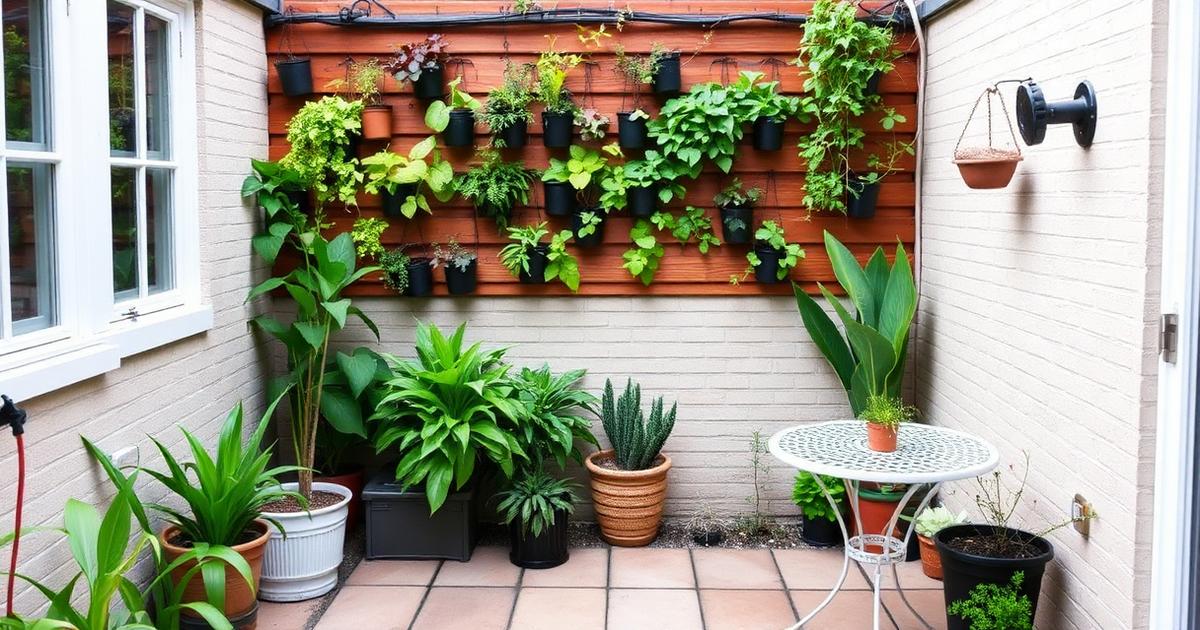
In small backyards, vertical space is your most underutilized asset. Walls, fences, and overhead structures multiply your planting and design potential without consuming precious floor area:
- Living walls: Modular planting systems or simple trellis panels with climbing plants turn blank walls into lush green features
- Tiered planters: Stepped containers or built-in raised beds create depth and visual interest in minimal footprint
- Overhead canopy: A pergola with climbing plants (wisteria, jasmine, grape) adds a living ceiling that makes the space feel room-like and protected
- Hanging gardens: Suspended pots, macrame holders, or rail-mounted planters add greenery at eye level and above
- Espalier trees: Fruit trees trained flat against walls provide beauty, shade, and even food in just 12 inches of depth
3. Use Diagonal Lines
The longest line in a rectangle is the diagonal. By orienting your main design element — a path, a patio shape, or a planting bed — along the diagonal of your yard, you maximize the perceived length. A diagonal deck or angled paving pattern can make a square yard feel significantly more spacious than a design aligned with the boundaries.
4. Manage Sight Lines
Control what the eye sees and when it sees it. Draw attention to a beautiful focal point (a water feature, specimen tree, or art piece) and away from boundaries. Tricks that work:
- Focal points at the back: A sculptural plant or water feature at the far end draws the eye and makes the space feel deeper
- Soften boundaries: Fence-mounted planting or climbers prevent the eye from stopping at the hard edge
- Graduated plant heights: Lower plants near the viewer and taller plants at the back create forced perspective
- Mirrors: An outdoor mirror on a back wall, partially hidden by plants, creates the illusion of a garden continuing beyond
Small Backyard Layout Ideas
The Courtyard Garden (200-400 sq ft)
Inspired by Mediterranean and Middle Eastern traditions: central patio with a small fountain or water bowl as the focal point, surrounded by raised beds or containers along every wall. Climbing plants on all vertical surfaces. Overhead shade structure over the seating area. Materials: natural stone, terracotta, warm-toned gravel. Plants: Mediterranean herbs, climbers, citrus in pots.
The Multi-Level Retreat (300-500 sq ft)
Changes in level create distinct zones: a raised deck off the house for dining, steps down to a gravel garden for planting, and a lower seating area at the back. Each level change makes the space feel larger and more complex. Use retaining walls as planting opportunities and add integrated lighting for evening ambiance.
The Vertical Garden Room (Under 200 sq ft)
When ground space is extremely limited: every surface becomes a planting opportunity. Living wall panels, stacked planters, a narrow raised bed along one side, and a compact bistro table for two. Overhead, a simple wire grid supports climbers that create a green ceiling. This approach can transform even a tiny urban patio into a garden oasis.
The Japanese-Inspired Pocket Garden
Minimalist approach: raked gravel or moss as the ground plane, one or two carefully chosen specimen plants, a stone lantern or water basin as the focal point, and bamboo screening for privacy. Every element is placed with precise intention. This style is ideal for narrow side yards or tiny enclosed spaces where simplicity creates calm.
Smart Features for Small Backyards
Multi-Functional Elements
In small spaces, every element should serve at least two purposes:
- Bench seating with storage underneath — Stores cushions, tools, or toys while providing seating
- Raised beds at seating height — Double as perimeter seating for gatherings
- Pergola with rain cover — Creates outdoor room usable in light rain
- Living privacy screens — Tall grasses or bamboo in narrow planters provide privacy while adding greenery
- Fold-down tables — Wall-mounted tables that fold flat when not in use
Water Features Scaled for Small Spaces
Water features add life, sound, and movement to small gardens. The sound of running water masks urban noise and creates a sense of sanctuary. Scaled-down options include:
Wall fountains: Mounted on a fence or wall, they add the sound of water without consuming any floor space. Available in styles from classical lion heads to sleek modern sheets of water.
Container water gardens: A large bowl or half-barrel with a small pump creates a miniature pond. Add a few water plants and you have a complete water garden in 3 square feet.
Bubble rocks: A drilled stone with water bubbling up from the center. Self-contained, safe (no standing water), and endlessly relaxing to watch and listen to.
Lighting That Transforms
Strategic lighting makes a small backyard feel magical at night — and effectively doubles the hours you can enjoy it. Key approaches for small spaces:
String lights: Overhead string lights (LED Edison bulbs or fairy lights) create a canopy of warm light that defines the space and adds instant atmosphere. Zigzag them across the space at 8-10 feet height.
Uplighting: Small LED spotlights aimed up at textured walls, specimen plants, or trees create dramatic shadows and depth. Two or three well-placed uplights can transform a flat space into a theatrical scene.
Candle clusters: Groups of candles (real or LED) on tables, steps, and ledges add warmth and intimacy that no other light source can match.
How AI Optimizes Small Space Design
AI design tools are particularly valuable for small backyards because proportions matter more. In a large yard, an oversized patio or slightly wrong plant placement is forgivable. In a small space, every element is visible and its relationship to everything else is critical.
Here's how AI helps:
- Upload your small yard photo — The AI immediately understands the scale and boundaries
- See multiple layout options — Test different configurations without physically moving anything
- Visualize vertical solutions — See how climbing plants, pergolas, and vertical gardens would look in your space
- Experiment with styles — Try Japanese, Mediterranean, modern, or cottage approaches to see what resonates
- Scale-appropriate suggestions — AI knows not to suggest a 20-foot tree in a 15-foot yard
The Small Backyard Checklist
Before designing, answer these questions: (1) What activities must the space support? (dining, play, relaxation, gardening), (2) How many people need to use it simultaneously?, (3) What's your privacy situation? (overlooked by neighbors?), (4) How much sun does the space get?, (5) What's your maintenance tolerance? Your answers determine the design direction far more than the space itself.
Plants That Work in Small Backyards
Small trees (under 15 feet): Japanese maple, serviceberry, crape myrtle, olive, dwarf magnolia — these provide canopy without overwhelming the space.
Narrow screening plants: Bamboo in contained planters, Italian cypress, columnar hornbeam, tall ornamental grasses — privacy without bulk.
Container-friendly plants: Hydrangeas, dwarf citrus, ferns, hostas, boxwood — perfect for flexible, moveable gardens.
Climbers: Star jasmine, climbing hydrangea, clematis, passionflower — multiply your garden space by going vertical.
Maximize Your Small Backyard
Upload a photo of your compact outdoor space and see how AI can help you make the most of every square foot. Discover layouts, vertical solutions, and design ideas tailored to your specific dimensions.
Try AI Small Space Design Free →