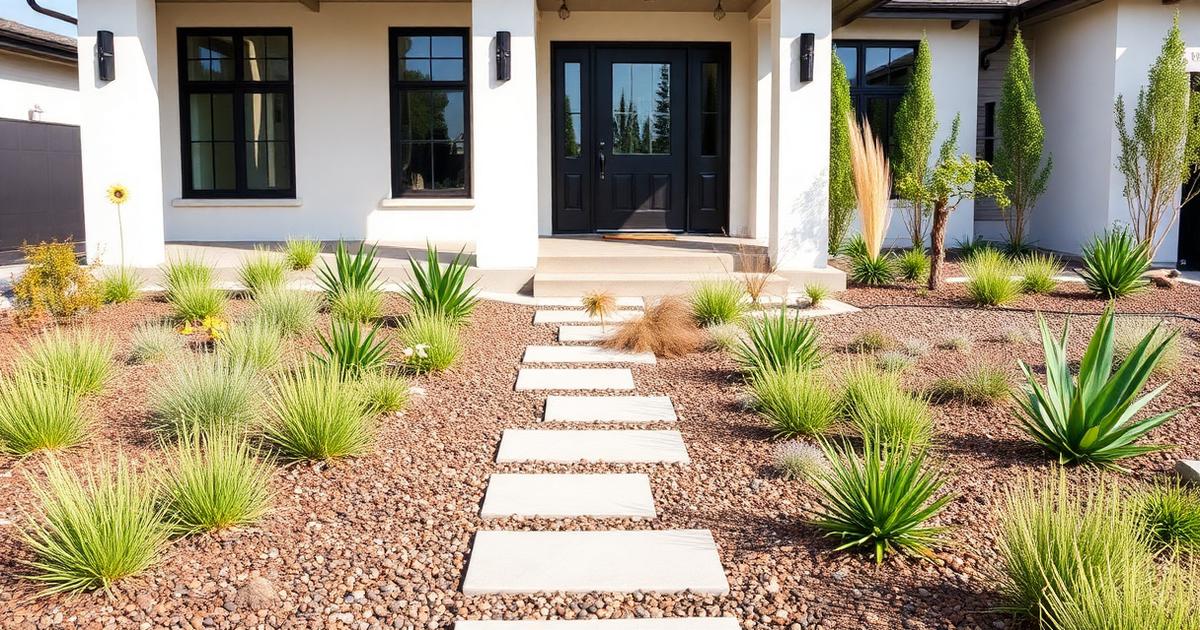
Front yard landscaping trends in 2025 lean toward naturalism, sustainability, and low-maintenance beauty. Homeowners are moving away from the uniform green lawn and cookie-cutter foundation plantings that dominated suburban landscapes for decades. Instead, the focus is on personality, ecological responsibility, and designs that actually reduce weekend work.
Here are the six biggest front yard trends we're seeing in 2025, with practical advice on how to implement each one.
Page Contents
1. Native Plant Gardens
Native planting is the biggest trend in 2025 front yard design, and it's not just an aesthetic choice — it's an ecological one. Native plants have evolved to thrive in your specific region's soil, climate, and rainfall patterns, which means less watering, less fertilizing, and fewer pest problems.
Homeowners are replacing traditional foundation shrubs like boxwood and yew with regional native plants that support local pollinators. In the Northeast, this means plants like Joe Pye weed, black-eyed Susan, and New England aster. In the Southeast, try coneflowers, coral honeysuckle, and native azaleas. Pacific Northwest gardens are incorporating Oregon grape, salal, and sword fern.
Why Native Plants Win in 2025
Water savings: Native plants typically require 50-75% less watering once established compared to traditional ornamentals
Pollinator support: Native plants provide food and habitat for local bees, butterflies, and birds
Lower maintenance: No need for fertilizers, pesticides, or constant pruning to keep them healthy
Year-round interest: A well-planned native garden provides color, texture, and structure in every season
Resilience: They're adapted to your local weather extremes — drought, cold snaps, heat waves
The key to a successful native plant front yard is treating it as a designed garden, not a wild meadow (unless that's specifically what you want). Use clean edges along walkways and property lines, arrange plants in deliberate groupings, and include some structural elements like stone or mulched paths to show that the plantings are intentional.
2. Meadow-Style Front Yards
Replacing front lawns with wildflower meadows or prairie-style planting is one of the most dramatic trends of 2025. Cities across the country are loosening lawn ordinances to allow naturalistic front yard plantings, and homeowners are taking advantage.
A meadow-style front yard isn't just scattering wildflower seeds and hoping for the best. It requires planning, soil preparation, and the right seed mix for your region. The best meadow gardens include a mix of grasses and flowering perennials that bloom in succession from spring through fall.
Meadow Implementation Steps
Step 1: Remove existing lawn by smothering with cardboard/mulch (6-8 months) or sod cutting
Step 2: Amend soil minimally — most meadow plants prefer lean soil, not rich garden soil
Step 3: Choose a regional seed mix from a reputable supplier (Prairie Moon, Ernst Conservation Seeds)
Step 4: Sow in fall or early spring. Press seeds into soil surface — don't bury them
Step 5: Mow to 4-6 inches in the first year to suppress weeds while plants establish
Step 6: In subsequent years, mow once in late winter/early spring before new growth
One practical consideration: keep a 2-3 foot mowed border along sidewalks and property lines. This creates a "frame" that signals intentional design and prevents the meadow from looking neglected. It also keeps neighbors and HOAs happy.
Cost comparison: A traditional lawn costs $500-1,500/year in maintenance (mowing, fertilizing, watering). A meadow garden costs $200-500 to establish and virtually nothing to maintain afterward. The return on investment is typically under two years.
3. Mixed Material Walkways
Combining materials in walkways is adding personality and texture to front yards in 2025. The single-material concrete path is giving way to creative combinations that reflect the homeowner's style and the house's architecture.
Popular combinations include flagstone with gravel joints, pavers with grass between them, concrete stepping stones in decomposed granite, and brick borders with stone infill. The mix of materials creates visual interest and a more relaxed, organic feel than a single uniform surface.
Popular Material Combinations
Flagstone + pea gravel: Classic, organic feel. Works with cottage, Mediterranean, and traditional homes. Cost: $12-25/sq ft
Large-format pavers + ground cover: Modern look with living joints. Dymondia, creeping thyme, or dwarf mondo grass between pavers. Cost: $15-30/sq ft
Concrete + exposed aggregate: Contemporary and clean. Different aggregate colors create subtle patterns. Cost: $10-20/sq ft
Brick + bluestone: Traditional elegance. Brick borders with bluestone field creates a refined New England aesthetic. Cost: $20-35/sq ft
When redesigning your front walkway, consider width. Most front walks are too narrow — 36 inches is the bare minimum, but 48-60 inches allows two people to walk side by side comfortably and feels much more welcoming. A wider walkway also makes your entrance feel more generous and inviting.
4. Vertical Layering
Front yard planting in 2025 emphasizes layers: tall trees in the background, mid-height shrubs in the middle, and low perennials and ground covers in the foreground. This creates depth, makes small yards feel larger, and provides year-round visual interest.
The classic three-layer approach works for any size yard. A single ornamental tree (Japanese maple, crape myrtle, or serviceberry) provides the canopy layer. Medium shrubs like hydrangea, viburnum, or holly create the middle layer. Perennials, grasses, and ground covers fill the front edge.
Sample Layering Plan (10x20 ft bed)
Back row: 1 ornamental tree (6-15 ft mature height) + 2-3 tall grasses or shrubs
Middle row: 3-5 medium shrubs (3-5 ft) in odd-number groupings
Front row: 7-9 low perennials and grasses (12-24 inches) for continuous color
Edge: Ground cover or low border plant that spills softly onto the walkway
The most common layering mistake is planting everything at the same height. Even a difference of 6 inches between layers creates visual depth. Plant the tallest elements at least 3 feet from the house to allow for air circulation and mature growth.
5. Modern Minimalism
Clean lines, limited plant palettes, and architectural elements define the modern minimalist front yard. This trend suits contemporary homes but also works surprisingly well to update mid-century and ranch-style houses.
The key to minimalist design is restraint — using fewer plant varieties but placing them with precision. A single species of ornamental grass repeated in a linear bed, a pair of symmetrical containers flanking the front door, or a carpet of one ground cover can be more impactful than a mixed cottage border.
Materials in minimalist front yards tend toward concrete, steel, and composite — clean-edged planters, geometric pathways, and simple water features. The color palette is usually restrained: green, white, and one accent color. Hardscaping does more work than planting, and negative space (open areas without plants) is treated as a design element, not empty space to fill.
6. Edible Front Yards
Growing food in the front yard is moving from counterculture to mainstream. Fruit trees, herb borders, and attractive vegetable beds are becoming common elements in front yard design, especially in neighborhoods where homeowners want to maximize productive use of their land.
The key is designing edible plantings that look ornamental. A fig tree is as beautiful as any ornamental tree. A border of lavender, rosemary, and sage is both functional and gorgeous. Blueberry bushes have excellent fall color. Rainbow chard and kale can be stunning in a well-designed bed.
Most Attractive Edible Plants for Front Yards
Fruit trees: Fig, apple (espalier), citrus (warm climates), cherry, pear
Berry shrubs: Blueberry, raspberry (in contained beds), currant
Herbs: Lavender, rosemary, sage, thyme, oregano — all excellent border plants
Ornamental edibles: Rainbow chard, purple kale, artichoke, rhubarb
Vines: Grape on a pergola, passion fruit on a fence, kiwi on an arbor
Visualize These Trends with AI
The hardest part of implementing any front yard trend is visualizing how it will look with your specific house, in your specific neighborhood. What looks great in a magazine photo might not suit your home's architecture or your street's character.
This is where AI design tools shine. Upload a photo of your current front yard to the AI front yard design tool and test different approaches. Generate a native plant garden, a modern minimalist look, and a mixed material walkway — all from the same photo — and compare which one best complements your home.
For more inspiration, check out our guides on boosting curb appeal with AI and real before-and-after transformations.
See These Trends on Your Home
Upload a photo of your front yard and generate concepts in the latest 2025 styles. Free to start.